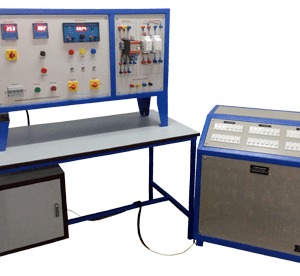
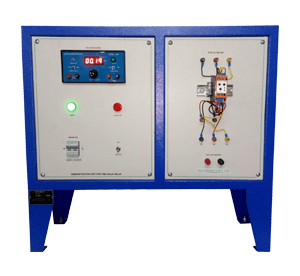
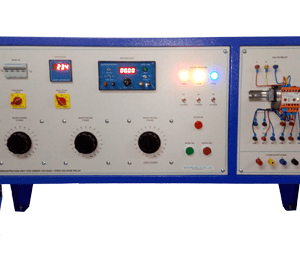
Protection has assumed a large importance in the power industry in the recent years. This protection involves the use of relays on a large scale. Relays are basically used to give commands to circuit breakers, contactors, etc by sensing different parameters like current, voltage, etc. Just as electrical circuits may range from a few watts to 100 megawatts, the size and rating of the relays vary considerably. Study of relays is now being included in the engineering curriculum. M/S SCR Elektroniks have developed demonstration units for different types of relays such as under protection/over protection relay, temperature protection relay, motor protection relays, AC/DC relays and contactors keeping the engineering curriculum in view.
Protection has assumed a large importance in the power industry in the recent years. This protection involves the use of relays on a large scale. Relays are basically used to give commands to circuit breakers, contactors, etc by sensing different parameters like current, voltage, etc. Just as electrical circuits may range from a few watts to 100 megawatts, the size and rating of the relays vary considerably. Study of relays is now being included in the engineering curriculum. M/S SCR Elektroniks have developed demonstration units for different types of relays such as under protection/over protection relay, temperature protection relay, motor protection relays, AC/DC relays and contactors keeping the engineering curriculum in view.
Protection has assumed a large importance in the power industry in the recent years. This protection involves the use of relays on a large scale. Relays are basically used to give commands to circuit breakers, contactors, etc by sensing different parameters like current, voltage, etc. Just as electrical circuits may range from a few watts to 100 megawatts, the size and rating of the relays vary considerably. Study of relays is now being included in the engineering curriculum. M/S SCR Elektroniks have developed demonstration units for different types of relays such as under protection/over protection relay, temperature protection relay, motor protection relays, AC/DC relays and contactors keeping the engineering curriculum in view.
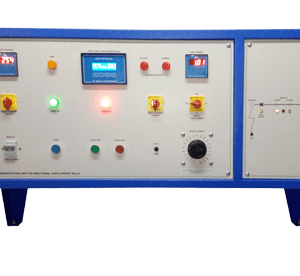
This is a demonstration panel to show the working of “DIRECTIONAL OVER CURRENT RELAY”. A protective relay is a device designed to trip a circuit breaker when a fault is detected.
A directional relay uses an additional polarizing source of voltage or current to determine the direction of a fault. The fault can be located upstream or downstream of the relay’s location, allowing appropriate protective devices to be operated inside or outside of the zone of protection.
Protection has assumed a large importance in the power industry in the recent years. This protection involves the use of relays on a large scale. Relays are basically used to give commands to circuit breakers, contactors, etc by sensing different parameters like current, voltage, etc. Just as electrical circuits may range from a few watts to 100 megawatts, the size and rating of the relays vary considerably. Study of relays is now being included in the engineering curriculum. M/S SCR Elektroniks have developed demonstration units for different types of relays such as under protection/over protection relay, temperature protection relay, motor protection relays, AC/DC relays and contactors keeping the engineering curriculum in view.
This equipment is made to test the electrical insulating material by exposing it to Arcing under high voltage. The test specimen is placed under electrodes, spaced at a distance of 6.35mm as per ASTM D 495. An Arc is generated between these electrodes. The test consists of 7 Cycles starting from cycle 1. As the cycles progress the test becomes progressively severe. The test specimen that has lower insulating strength fails earlier in the first few cycles while those with higher insulating strength sustain higher cycles. The test is halted when the specimen fails and the time taken from the start of the test till the failure is used for comparing INSULATING STRENGHTS (time in seconds) of various insulating materials. The test specimen may fail by forming a conducting path, by burning into flames, by melting or any other physical, visual deformities.


 WhatsApp